
I revisited the price of U.S. first-class postal stamps this weekend, after creating a virtual birthday card to send electronically to someone.
Backstory
Back in the day, my mom and grandmother would send physical birthday, holiday, and other cards in volume, especially for Christmas. They’d also receive stacks of cards from friends and family. As for me, I was never a big card sender, although I still do send some physical cards on occasion.
Anyway, I’ve been more conscious of sending mail because I’ve watched the price of stamps increase rapidly in the last many years. Add in the price of a decent envelope, and the combined price to send a one-ounce first-class piece of mail might surpass one dollar in the near future.
For instance, on 12 July 2026, the U.S. Postal Service (“USPS”) wants to increase the price of a single stamp to $.82. So, for those who bought stacks of forever stamps back in 2007 when they were first offered at $.39–$.41 made a decent investment decision.
All this said, I ran some data through Python to see whether it could create some compelling charts.1
Chart: Stamp Price History — Linear
Here’s a linear chart of U.S. first-class stamp prices going back to 1885 (click to enlarge).
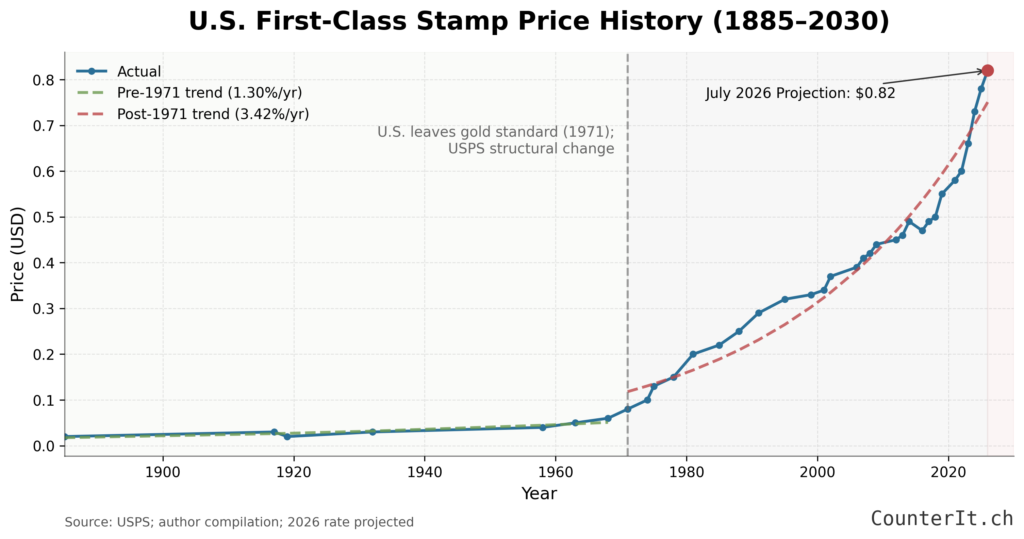
Just based on the linear chart, one might notice the beginning of a shift to noticeably higher prices. Also, understand that inflation prior to the early 1900s was essentially non-existent:
For over a hundred years after America’s founding—roughly 1774 to 1900—prices did not steadily rise. Net cumulative inflation over that entire century was close to zero. Prices often fell, not because of poverty or collapse, but because of human ingenuity: more efficient factories, labor-saving machines, railroads slashing transportation costs, etc. Each new invention meant goods cost less to make and less to buy. Economists call this “good deflation”—the natural, healthy fruit of a productive economy.
Mises Institute: “The Theft of Your Good Deflation.” 09 April 2026
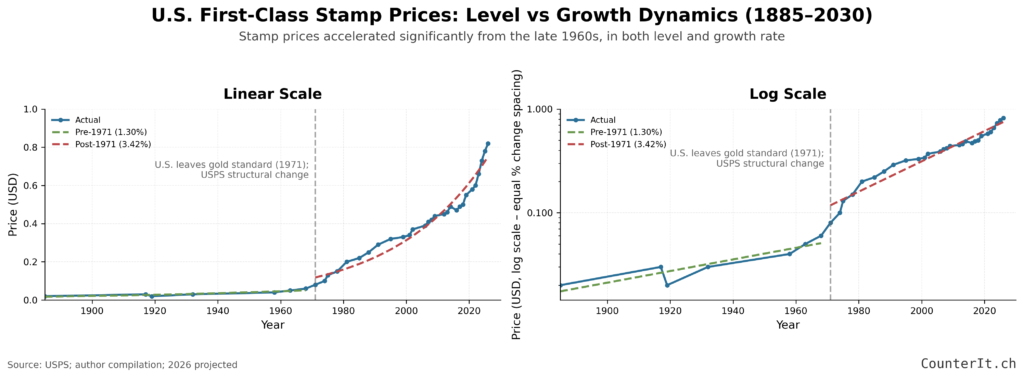
Nevertheless, the dashed green and red trend/regression lines illustrate this change, showing a 1.30% growth rate trend prior to 1971 and a 3.42% growth rate since 1971. That’s a huge difference. For instance, if one uses the simple Rule of 72,2 then it would take 55 years for the price to double at 1.30% annual growth. However, it would take only 21 years for the price to double at 3.42% annual growth.
There are many explanations for this shift, including a poorly run service, growing suburban neighborhoods, and even an increase in volume of deliveries.
Two notable points about 1971
I put a line in the chart at 1971 because leading up to that year several factors came together to force price increases for stamps, with two notable points, in addition to the other explanations already briefly noted.
Gold standard
In 1971, President Nixon removed the U.S. dollar entirely from the gold standard. This was the start of the end for most of the society due to the continual and intentional loss of purchasing power of the dollar. We often just call this “inflation,” which can be misleading:
There’s only one kind of inflation. Inflation by definition is an expansion of the supply of money and credit and we’ve had a massive monetary expansion now for decades. So we’re running a monetary policy that’s built on inflation. That’s just how everything’s been going and I think the war itself is inherently gonna end up being inflationary because the war is going to cost a lot of money.
SchiffGold: “Inflation and the Real Cost of War.” 21 March 2026
Also, note that the U.S. government significantly changed the methodology of inflation (CPI) in 1998, so figures after that date are not directly comparable to CPI figures prior to that date. A lot of people who have an understanding of this realize that real inflation (loss of purchasing power) is noticeably greater than “headline” government CPI.
How much so?
Some say 2–3 times the headline figure, if not more. It will vary in a given year, period, geographic region, and situation (buyer/renter; typical “basket of goods” purchased; etc.):
If you calculate inflation the old-school way, inflation hasn’t been 2–4% over the years — it’s more like 6–10%, sometimes higher.
North Trends: “Beyond the Basket: How ShadowStats Reveals Decades of Hidden Inflation.” 17 May 2025
To this point, an article on the Mises Institute titled “Which to Believe: The Official CPI or Zoe Dippel’s Grocery Receipts?” indicated that real inflation has averaged between 4 and 5 percent per year from 1997 to 2025, when assessing a basket of food and housing prices (but not factoring-in hidden costs such as HOA fees, home insurance, property taxes, energy, and maintenance).3 So, this is a back-of-the-envelope, very conservative estimate of real inflation. The headline CPI, incidentally, published by the government over this period is 2.5%.
Big difference!
USPS structural changes
After losing lots of money (a $2.6 billion expected deficit in 1970) and then having 209,000 workers go on mass strike in 1970, President Nixon restructured the postal department. So, in July 1971, “new federal legislation established the USPS as a new independent agency and required it to ’pay for itself’ — meaning the agency would receive no tax dollars and instead fund itself directly through the sale of its postage, products, and services.”
This legislation also enabled full collective bargaining for pensions, wages, and work conditions. So, instead of receiving federal subsidies, the USPS had to begin funding itself entirely.
This helps to explain the price increases from a non-monetary/inflation viewpoint, as well.
Chart: Stamp Prices — Log Scale
Often times when someone shares a linear chart that shows huge increases over time — such as stamp prices, some stock prices, the national debt — certain smart people quickly ask to see a log scale chart.4 The latter basically transforms the y-axis so that an equal vertical distance equates to an equal percentage change, not an equal dollar change (in the stamp price example), as in a linear chart.
So, here’s a hybrid log scale chart, which incorporates the same math (logarithmic), but with a more intuitive y-axis based on price that’s more understandable to an Average Joe:
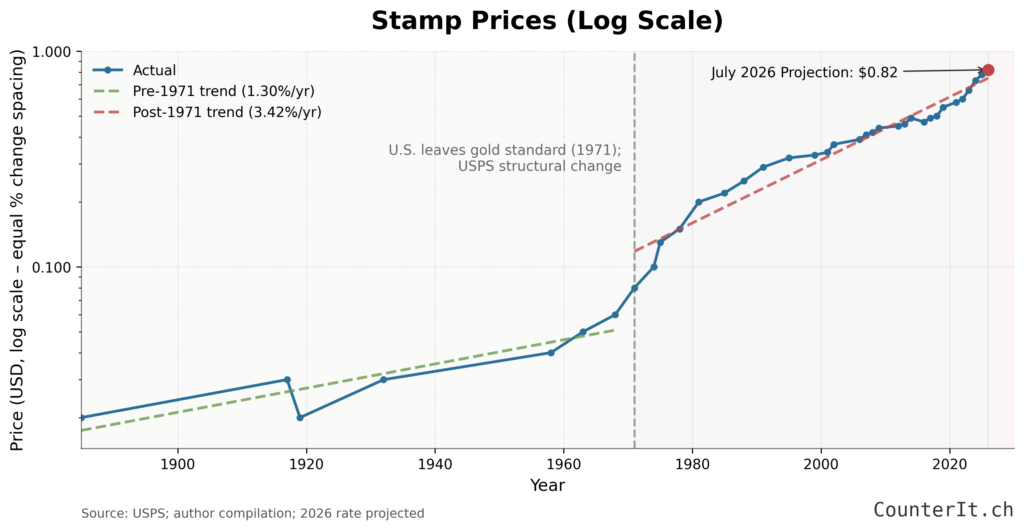
Here’s how to interpret the chart:
- A steeper slope = high growth rate.
- Parallel lines = similar growth rates.
- Curve flattening = slowing growth.
The takeaway is that the hybrid log chart also supports the linear chart, and this is not always the case. The slope of the trend/regression lines show the rate of growth; the steeper the line, the greater the growth rate. Also, the y-axis shows an equal percent-change by the spacing between two given price points on the axis.
Chart: Side-by-Side — Linear vs. Log
I thought I’d go the extra mile, so to speak, and show the linear and log charts side-by-side for easier comparison and insight (click to enlarge).
Inflation Hedge
The forever stamps protect consumers against future price increases, serving as an inherent inflation hedge. Also, remember, the headline “inflation” the government uses is manipulated and grossly understated (as previously mentioned), so consumers are getting a hidden better deal:
What happens when people buy cheaper substitutes because their usual foods have become unaffordable? The Consumer Price Index doesn’t account for these common, day-to-day economic realities. For example, If the price of steak goes up 30%, prompting families to switch to rice and beans, congratulations—the model assumes inflation hasn’t occurred, because now people are “spending less” on food by buying cheaper protein sources. The official inflation rate gets smoothed out with accounting tricks, even as savers watch their purchasing power slowly, steadily melt away.
SchiffGold: When the Data Is Bad, Just Lie. 15 August 2025.
Moreover, the USPS is somewhat limited to the amount of price increases it implements, mainly because it needs regulatory approval for any price increases. And, if the USPS really wanted to increase prices by a realistic 10% in a year, they’d probably get regulatory push-back because raising it that much might bring too many questions and ultimately attention to real inflation.
Additionally, regulators recently reduced the frequency of price increases from twice a year to only once a year (presumably to occur in July of each year). So, if the proposed increase on 12 July 2026, from $.78 to $.82 (a 5.13% increase), is approved, then we won’t experience another price increase until July 2027. Accordingly, if one stocks-up before July, one could very well likely achieve a >10% annual return, provided USPS increases the rates comparably in July 2027 (another 5%, or more). Easy money!5
Relative Value
Lastly, based on global comparisons, the price of U.S. postage stamps seems to be a good relative value; in fact, they are among the cheapest in the developed world. As of 2023, when the U.S. postal stamp cost $.63, only Japan, Brazil, Serbia, and Russia had lower stamp prices ($.40–$.56). Italy, Finland, Estonia, and Iceland led the way with the highest stamp prices ($2.03–$2.96)! Also, during the period of 2018–2023, U.S. postal stamps increased about 26% while the 30-nation sample had an average price increase of 55%.
What’s even more notable about the price of U.S. postal stamps:
When the OIG adjusted its analysis for purchasing power parity — a currency conversion rate used to compare the relative affordability of goods in different countries — the U.S. had the lowest stamp price of the 31 postal services.
NPR: “The Forever Stamp just went up in price. How does the U.S. cost compare globally?” 15 July 2024
The lower relative price of U.S. first-class postal stamps might be partly attributable to economies of scale as the U.S. mail market is also relatively large.
Closing Words
So, this exercise helps me and others get into a mindset of how to mitigate the effects of inflation as well as assess relative investments. It’s somewhat similar to the perspective of what assets you’d want to put your fiat currency into. Gardens, Goats, Guns, and Gold are obviously foundational.
The bottom line is, I expect stamp prices to continue to increase but at a faster growth rate.
Why?
It really goes back to those two main points related to 1971:
- We are no longer on a gold/silver standard.
- Structural changes at the USPS.
Our government is unable or unwilling to balance the budget,6and the national debt is out of control (now at $39 trillion). As for the structural changes, there’s increasing pressure to privatize USPS.
Accordingly, the USPS could face a resurgence of, and scrutiny by, the Department of Government Efficiency (DOGE), or its equivalent, again in the near future. To compound this pressure to become more efficient, the USPS faces the ever-growing pension and health care liabilities of its workforce. It needs to fund both of these (an increasing loss of purchasing power and surging retirement liabilities) through improved efficiency and price increases of stamps and services.
NPR reported on March 17 that USPS could run out of cash as early as October 2026 if it continues paying all obligations at current levels.
FedTools.com: “USPS Financial Crisis 2026: What Postal Workers Need to Know.” 12 April 2026
In the meantime, I will increase my stake in stamp investments and buy more forever stamps before the USPS likely jacks-up the prices again this July to $.82.
But, I’ll temper my arbitrage enthusiasm, given the financial dire straits of the USPS and lack of trust in the crooked government (will it even honor forever stamps if the USPS essentially goes belly up, financially speaking?).
Let’s see what happens.
Footnotes
- Spreadsheets such as Excel and LibreOffice Calc are very capable of creating the charts (maybe not the side-by-side one) quickly and easily, especially with such a small data set. However, Python is scalable (analyze millions of rows of data) and less error-prone, albeit with a steeper learning curve, but with huge dividend payouts for reuse. The programs that created these charts may be reused as templates whereby the workflow becomes mostly automated (80%–95% so) for future purposes. ↩︎
- Divide 72 by the growth or interest rate to estimate how many years it would take to double the price. For example, if an annual growth rate is 12.0%, then the Rule of 72 estimates that the price would double in 6 years (72 divided by 12). ↩︎
- Anyone who has owned a home, especially in Ohio, Texas, and Florida, can tell you that the “hidden” costs of owning a home have skyrocketed: property taxes, insurance, maintenance, HOA fees, energy, and other local regulatory requirements. ↩︎
- Logarithmic (Log) Charts: Depict percentage (relative) changes, with spacing on the y-axis corresponding to equal percentage moves. A rise from 50 to 60 (20% increase) is shown similarly to a rise from 10,000 to 12,000 (also a 20% increase). ↩︎
- Not really. It’s just mitigating one’s loss of purchasing power. ↩︎
- The last time the U.S. federal government had a balanced budget was in 2001 under President Bill Clinton. Prior to 2001, the previous balanced budget occurred in 1969 under President Lyndon B. Johnson. ↩︎