This is just a snippet of a Happy Easter 20261Hat tip to CoolCatholics.org, which shares compelling posts on Facebook. packet CounterIt.ch and CoventryLeague.com sent to their Swiss financiers and small network.
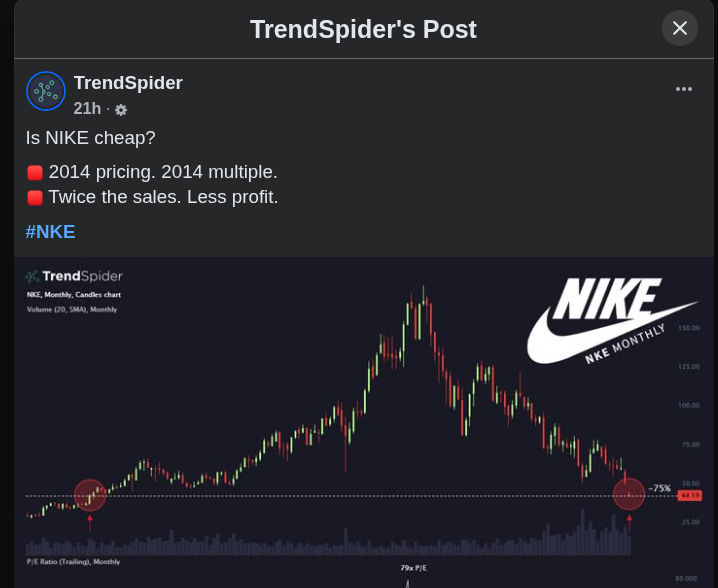
Is Nike Cheap?
Since spring is also about renewal and new opportunities, beginnings, and outlooks — it makes sense that our packet incorporated this, albeit in the language of finance, capital markets, and Python Coding.
As such, given TrendSpider asked whether Nike (NYSE: NKE) is cheap, we thought we’d share a snippet of a project related to a trade we are working on.
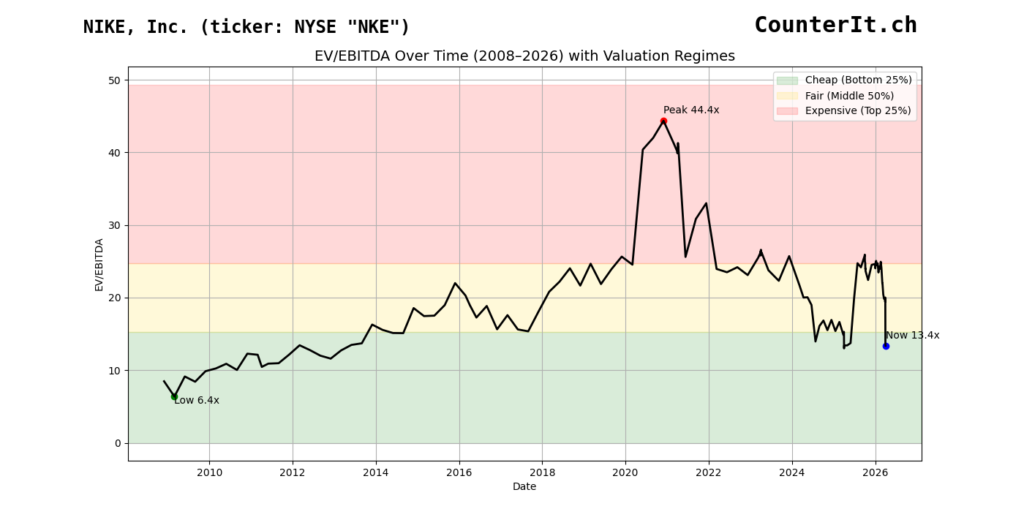
Nike’s EV/EBITDA Valuation Multiple
To that end, Coventry League’s brilliant investment analyst shared this chart with me and CounterIt.ch concerning Nike’s historical EV/EBITDA valuation multiple and attractiveness.
I won’t delve into a long/short pairs trade that involves one or more other companies.
Thinking Outside the Box
Essentially, though, the idea is not only to think of a particular trade in an absolute, independent, directional perspective, but also to think of a particular trade as relative, interdependent, and derivative.2Consider, for instance, derivatives in Calculus: derivative order; physical meaning; graphical meaning. First, Velocity, Slope of the curve; Second, Acceleration, Concavity (curvature); Third, Jerk, Rate of change of concavity.Some might say this is “thinking outside the box.”
Python Coding
Here is the base Python code, which may be customized:
import pandas as pd
import matplotlib.pyplot as plt

# ---- FULL DATA (Date, EV/EBITDA) ----
data = [
("04/02/2026",13.36),("04/01/2026",13.49),("03/31/2026",20),("03/30/2026",19.39),
("03/27/2026",19.83),("03/20/2026",19.83),("03/13/2026",20.45),("03/06/2026",22),
("03/05/2026",22),("03/04/2026",22.24),("03/03/2026",22.53),("02/25/2026",24.08),
("02/19/2026",24.93),("02/13/2026",23.97),("02/06/2026",24.28),("01/30/2026",23.46),
("01/23/2026",24.71),("01/16/2026",24.45),("01/09/2026",25.05),("01/06/2026",24.83),
("01/05/2026",24.51),("01/02/2026",24.03),("12/31/2025",24.63),("12/01/2025",24.50),
("10/31/2025",22.42),("10/09/2025",23.64),("10/08/2025",24),("10/07/2025",23.93),
("10/06/2025",24.72),("10/03/2025",24.99),("10/02/2025",25.91),("10/01/2025",25.78),
("08/29/2025",24.16),("07/30/2025",24.73),("06/30/2025",19.88),("05/30/2025",13.73),
("04/30/2025",13.41),("04/04/2025",13.41),("04/03/2025",13),("04/02/2025",15.27),
("04/01/2025",15.22),("03/31/2025",14.91),("03/28/2025",14.86),("02/21/2025",16.64),
("01/17/2025",15.39),("12/13/2024",16.92),("11/08/2024",15.51),("10/04/2024",16.84),
("08/30/2024",16.09),("07/26/2024",13.95),("06/21/2024",18.98),("05/17/2024",20.04),
("04/12/2024",20),("03/08/2024",21.66),("12/08/2023",25.71),("09/08/2023",22.31),
("06/09/2023",23.76),("04/10/2023",26.20),("04/06/2023",25.83),("04/05/2023",25.98),
("04/04/2023",26.58),("04/03/2023",26.15),("03/31/2023",26.36),("03/30/2023",25.81),
("03/29/2023",26.12),("03/10/2023",25.46),("12/09/2022",23.10),("09/09/2022",24.18),
("06/10/2022",23.49),("03/11/2022",23.94),("12/10/2021",33),("09/10/2021",30.83),
("06/11/2021",25.60),("04/09/2021",40.76),("04/08/2021",40.22),("04/07/2021",41.09),
("04/06/2021",41.28),("04/05/2021",40.66),("04/01/2021",39.87),("03/31/2021",39.98),
("03/30/2021",40),("03/29/2021",40.16),("03/02/2021",41.15),("11/30/2020",44.35),
("08/31/2020",41.99),("06/01/2020",40.38),("03/02/2020",24.53),("11/29/2019",25.64),
("08/30/2019",23.89),("05/31/2019",21.86),("03/01/2019",24.66),("11/30/2018",21.65),
("08/31/2018",24.03),("06/01/2018",22.19),("03/02/2018",20.80),("11/29/2017",18.09),
("08/30/2017",15.35),("05/31/2017",15.61),("03/01/2017",17.58),("11/30/2016",15.63),
("08/31/2016",18.84),("06/01/2016",17.25),("04/05/2016",18.94),
("02/26/2016",20.29),("11/27/2015",21.99),("08/28/2015",18.96),("05/29/2015",17.51),
("02/27/2015",17.45),("11/28/2014",18.55),("08/29/2014",15.10),("05/30/2014",15.12),
("02/28/2014",15.55),("11/29/2013",16.28),("08/30/2013",13.70),("05/31/2013",13.48),
("03/01/2013",12.72),("11/30/2012",11.59),("08/31/2012",12),("06/01/2012",12.76),
("03/02/2012",13.43),("11/30/2011",12.13),("08/31/2011",10.96),("06/01/2011",10.90),
("04/05/2011",10.45),("02/28/2011",12.12),("11/29/2010",12.27),("08/30/2010",10.03),
("05/28/2010",10.88),("02/26/2010",10.24),("11/27/2009",9.86),("08/28/2009",8.41),
("05/29/2009",9.13),("02/27/2009",6.37),("11/28/2008",8.47)
]

df = pd.DataFrame(data, columns=["Date","EV"])
df["Date"] = pd.to_datetime(df["Date"])
df = df.sort_values("Date")

# ---- Percentile zones ----
p25 = df["EV"].quantile(0.25)
p75 = df["EV"].quantile(0.75)

# ---- Plot ----
plt.figure(figsize=(14,7))

plt.axhspan(0, p25, color='green', alpha=0.15, label='Cheap (Bottom 25%)')
plt.axhspan(p25, p75, color='gold', alpha=0.15, label='Fair (Middle 50%)')
plt.axhspan(p75, df["EV"].max()+5, color='red', alpha=0.15, label='Expensive (Top 25%)')

plt.plot(df["Date"], df["EV"], color='black', linewidth=2)

# Key points
peak = df.loc[df["EV"].idxmax()]
low = df.loc[df["EV"].idxmin()]
latest = df.iloc[-1]

plt.scatter(peak["Date"], peak["EV"], color='red')
plt.scatter(low["Date"], low["EV"], color='green')
plt.scatter(latest["Date"], latest["EV"], color='blue')

plt.text(peak["Date"], peak["EV"]+1, f'Peak {peak["EV"]:.1f}x')
plt.text(low["Date"], low["EV"]-1, f'Low {low["EV"]:.1f}x')
plt.text(latest["Date"], latest["EV"]+1, f'Now {latest["EV"]:.1f}x')

plt.title("EV/EBITDA Over Time (2008–2026) with Valuation Regimes", fontsize=14)
plt.xlabel("Date")
plt.ylabel("EV/EBITDA")
plt.legend()
plt.grid(True)

plt.savefig("ev_ebitda_full_chart.png", dpi=300, bbox_inches='tight')
plt.show()
Closing Words
So, yes, Nike has crossed the line to being considered “cheap” on a relative historical basis, and will likely become cheaper, perhaps to the single-digit EV/EBITDA multiple range.
As for the trade, it could be long, short, or some variant and still perform. It all depends on how the trade is structured relative to other securities and the portfolio.
That’s the secret sauce!
Footnotes
- 1Hat tip to CoolCatholics.org, which shares compelling posts on Facebook.
- 2Consider, for instance, derivatives in Calculus: derivative order; physical meaning; graphical meaning. First, Velocity, Slope of the curve; Second, Acceleration, Concavity (curvature); Third, Jerk, Rate of change of concavity.