
I’ve been so busy with work and domestic responsibilities, I haven’t taken the time to post on here in over a month. Nevertheless, given it’s Labor Day weekend, I made sure to take some time for rest and relaxation—although not too much—and create a post.
Friction of Independent Blogging
Creating a post on here does entail more friction than simply posting a few sentences and uploading an image on social media. A partial reason is social media performs a lot of the modifications for proper formatting. In contrast, on this blog, I need to crop and scale images to reduce their sizes, since the larger image sizes have a cumulative negative affect on my rented server. Furthermore, I have to edit the text and layout, add explanatory details to the images (captions, for example), and perform at least some proof reading (there isn’t a grammar or spell check). As such, posting on here is more time consuming, relatively speaking.
Labor Day Weekend
Yesterday and today (Labor Day) were practically ideal with respect to temperature and dew point (roughly 75°F and 58°F, respectively, here in Northeast Ohio (between Cleveland and Pittsburgh). The only exception was with one stupid yellow jacket that kept bothering me as I tried to read that big beautiful book by Fyodor Dostoevsky that I mentioned I had begun reading earlier this summer.
Also, my garden sunflowers are finally blooming.

Lastly, the icing on the cake for this Labor Day Weekend was a win for my beloved Fighting Irish of Notre Dame, which beat the Badgers of Wisconsin, 41–13, to start the 2026–2027 college football season.

Book: The Brothers Karamazov
Regarding my reading, I’m only through about 275 pages (33%) of the novel, The Brothers Karamazov (1880) by Fyodor Dostoevsky (1821–1881). My edition is 823 pages, not including the Notes. At my current pace, I’ll probably finish it by year end.
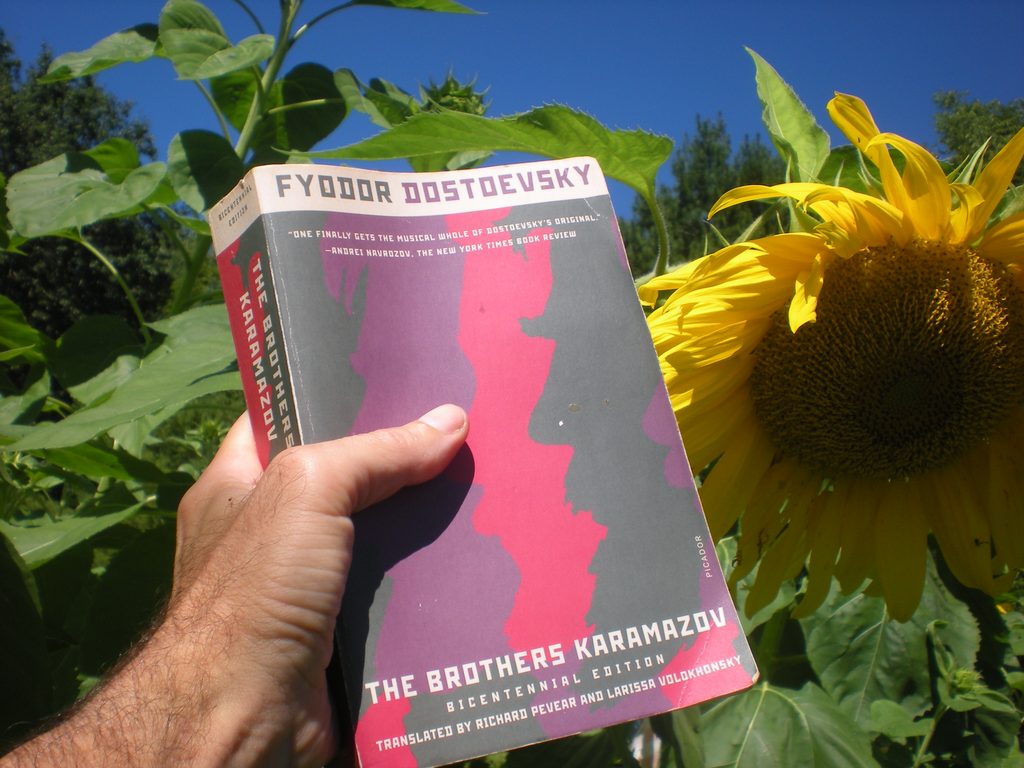
As you might notice in the above image, my book is the 2021 paperback version, bicentennial edition, translated and annotated by Richard Pevear and Larissa Volokhonsky.
Opinion So Far
Well, the first 250 pages were a bit underwhelming. I had really high expectations, so that’s part of the reason for my opinion. I got to a point of not really wanting to read more than 2–3 pages per day since the story was dragging on.
Think of being excited like a kid to experience a much-talked about roller-coaster. You wait in line for so long it seems like forever. Then, you finally get into a cart of the roller coaster train with your friends. But, they delay the action. When the roller-coaster eventually starts moving, slowly climbing up the tracks, you are still unimpressed. Yawn.
That’s my summary of the first 250 pages!
Enter Evan’s Story Telling
Then, Evan Fyodorovich, an atheist, starts telling stories of real-world events, and asking penetrating philosophical questions, in dialogue with his younger 20-year-old brother Alexei, a Christian monk-in-training.
So, beginning on page 251 is the equivalent of the roller-coaster dropping, hard. You scream, then become calm as Buddha—because you passed out! Then you wake up, momentarily, and pass out again!
Roller-coaster: Bro Having the Time of His Life!
The below video clip is of the Diamondback roller-coaster at Kings Island in Mason, Ohio.1
Considering this, and to Dostoevsky’s credit, he had me fooled for a while; so, I think he might deliver on the high expectations. After all, people have said this book is The Grand Finale of Dostoevsky’s body of work—not only his Swan Song, but also his Magnum opus.2
The Grand Inquisitor
The chapter before this one, “Rebellion,” is a prelude to this one, but it’s gruesome. It tells how some humans can be worse than undomesticated animals. Evil, incarnate. If you decide to read the novel, be forewarned.
But, that chapter leads to this chapter (pages 262–281), “The Grand Inquisitor.” Let’s just say, it makes one think, a lot.
Without spoiling any of the novel’s plot lines, Evan’s story—an absurd poem or parable, so to speak—is set in sixteenth century Seville, Spain during the Spanish Inquisition. Hosanna (Jesus) appears, just briefly to “visit his children if only for a moment, and precisely where the fires of the heretics had begun to crackle.” Everyone recognizes him. He heals the sight of a man who was blind since childhood. There’s a funeral for a little girl. Her mother sees Jesus and pleads for him to “raise my child.” The little girl rises.
This is when the Cardinal Grand Inquisitor, a ninety-year-old Roman Catholic man, appears and witnesses Jesus’s miracles. He orders the holy guard to arrest Jesus. That evening he visits Jesus in a prison vault. He tells Jesus that tomorrow he will condemn him and burn him at the stake as the most evil of heretics.
He tells Jesus that his mistake was wanting freedom for people, but people don’t want, or can’t handle, freedom (Evan, in the quote below, is telling the story to Alexei):
‘Have you the right to proclaim to us even one of the mysteries of that world from which you have come?’ my old man [The Grand Inquisitor] asks him [Jesus], and answers the question himself: ‘No, you have not, so as not to add to what has already been said once, and so as not to deprive people of freedom, for which you stood so firmly when you were on earth…. Was it not you who so often said then: “I want to make you free?” But now you have seen these “free” men,’ the old man suddenly adds with a pensive smile. ‘Yes, this work has cost us dearly,’ he goes on, looking sternly at him, ‘but we have finally finished this work in your name. For fifteen hundred years we have been at pains over this freedom, but now it is finished, and well finished….Know, then, that now, precisely now, these people are more certain than ever before that they are completely free, and at the same time they themselves have brought us their freedom and obediently laid it at our feet. It is our doing, but it is what you wanted? This sort of freedom?’
Evan replies to his brother, who asks whether the Grand Inquisitor was being ironic in his statements:
Not in the least. He precisely lays it to his and his colleagues’ credit that they have finally overcome freedom, and have done so in order to make people happy. ‘For only now’ (he is referring, of course, to the Inquisition) ‘has it become possible to think for the first time about human happiness. Man was made a rebel; can rebels be happy? You were warned,’ he says to him, ‘you had no lack of warnings and indications, but you did not heed the warnings, you rejected the only way of arranging for humans happiness, but fortunately, on your departure, you handed the work over to us. You promised, you established with your word, you gave us the right to bind and loose, and surely you cannot even think of taking this right away from us now. Why, then, have you come to interfere with us?’
Then, Alexei asks Evan to explain the notion of Jesus having had no lack of warnings and indications.
That is the main thing the old man needs to speak about.
‘The dread and intelligent spirit, the spirit of self-destruction and non-being,’ the old man goes on, ‘the great spirit spoke with you in the wilderness, and it has been passed on to us in books that he supposedly “tempted” you. Did he really? And was it possible to say anything more true than what he proclaimed to you in his three questions, which you rejected, and which the books refer to as “temptations?” And at the same time, if ever a real, thundering miracle was performed on earth, it was on that day, the day of those three temptations. The miracle lay precisely in the appearance of those three questions….
By the questions alone, simply by the miracle of their appearance, one can see that one is dealing with a mind not human and transient but eternal and absolute.
Temptation of Jesus
For reference, here are the three temptations (or questions, if you prefer) from Matthew 4:1–11:
- “If you are the Son of God, command that these stones become loaves of bread.”
- “If you are the Son of God, throw yourself down [from the parapet of the Temple].”
- “All these [the kingdoms of the world] I shall give to you, if you will prostrate yourself and worship me.”
For details of each temptation, reference the link above related to Matthew, or read the portion below from one of my Bibles:
Story Interpretation
In essence, “The Grand Inquisitor” and the three temptations, in this context, relate to a sliding spectrum, if you will, between liberty/free will and authority/control. There’s a balancing act between them, as the University of Notre Dame suggests on its blog, God and the Good Life, in a post titled “Fyodor Dostoevsky’s The Grand Inquisitor: Free Will vs Authority“:
The interaction between Christ and the Grand Inquisitor represents the struggle between free will and authority. Christ upholds the importance of free will, believing that humans must have the ability to choose between right and wrong without force or coercion. However, over the course of the passage the Grand Inquisitor argues that this freedom of choice burdens humans with too much responsibility. Humans are inherently selfish and weak, meaning the vast majority will not be strong enough to find salvation and will spend an eternity in hell. In response to this problem, the Grand Inquisitor explains that the Church helps relieve this burden of freedom by providing people with security. The Church adopts the authority to command people’s beliefs and choices. At the heart of the disagreement between the Grand Inquisitor and Christ is the decision to value either comfort or freedom: if humanity is free, humanity will not be happy.
In other words, the Church has corrected Jesus Christ’s work by providing bread, miracle, and authority to satisfy humanity’s weak nature, rather than leaving them with the burden of free will.
Closing Words
As you might sense, this book starts out slowly, and then goes down fast like a roller-coaster, into the depths of religious and philosophical questions. In particular, it discusses the idea of liberty versus control and why there is suffering in the world.
Note, too, that I skipped some of the religious jabs, or criticisms, in the chapter of “The Grand Inquisitor” that were directed at Catholicism, Jesuits, Protestantism (especially Lutheranism), and organized/institutional religion more broadly. But, also remember, Dostoevsky, himself, was a religious man of the Russian Orthodox Christian faith and many of his works infuse Christian elements and themes. Furthermore, he viewed Jesus Christ with great love.
The understanding of Christian unity by Fyodor Dostoevsky has a deep connection with his spiritual evolution. He evolved from being a revolutionary punished by hard labor for his ideas, to his perception of Christianity and the idea of the Church as the best social structure. Dostoevsky had a brush with death,3 spent four years of hard labor among murderers and criminals in Siberia, then a remote settlement in the harsh environment of North Kazakhstani Semipalatinsk, the illness of his first wife, addiction to gambling, love passions, a complete lack of money, the death of his brother, and the death of his youngest and beloved son, Alyosha [Alexei]. Nevertheless, he retained faith in man and humanity.
MDPI (Basel, Switzerland): “The Holy See and Fyodor Dostoevsky: Mutual Attraction and Repulsion.” (Feb. 2023)
With this said, I do hope the book continues on the more exciting train track, as it were, like that-roller coaster in the video clip. It’ll be a “fun” experience.
Either way, I’ll find out over the next several months.
Footnotes
- Mason, Ohio is situated approximately 24 miles (39 km) northeast of Cincinnati. ↩︎
- A magnum opus is an artist’s greatest or most significant work, representing the peak of their career, while a swan song is a creator’s final performance or work before death or retirement, which may or may not be their best. ↩︎
- He was arrested 23 April 1849 for participating in a circle of Petrashevists, imprisoned in the Peter and Paul Fortress, and sentenced to death by firing squad; at the very last moment the death sentence was commuted to hard labor. ↩︎