

My garden produced a nice little batch of pumpkins this year! I ate a big watermelon a few weeks ago, and now I have two small watermelons and a baby cantaloupe left over (which I’m keeping mainly for the seeds). I’ll save the pumpkin seeds to roast, since they are delicious and highly nutritious. I’m not entirely sure yet whether I’ll try to make a homemade pumpkin spice sauce for lattes, but it’s tempting.
Pumpkin Harvest 2026: Or, Will I Be Smashing Pumpkins This Halloween?
I don’t know, you tell me!
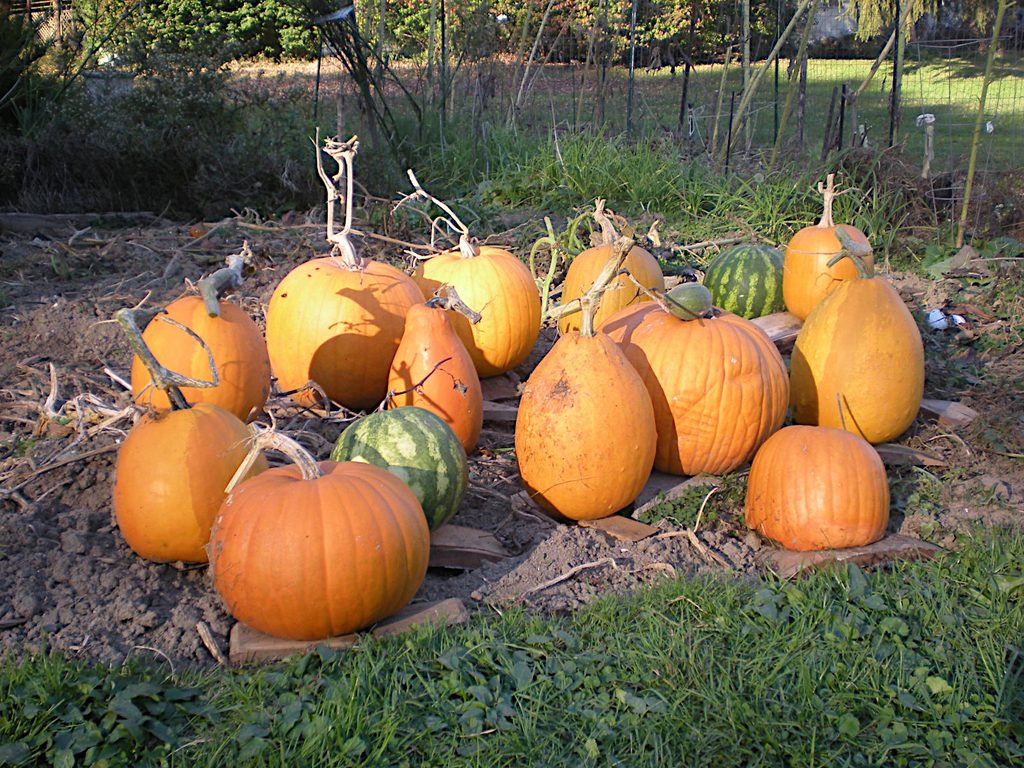
Picking them from the vine and setting them in the corner of the garden got me thinking about how easily a literal autumn harvest rolls right into seasonal pop culture. And what says late October more than a classic 90s alternative anthem carrying a famously spooky band name?
Smashing Pumpkins — Cherub Rock
I truly think “Cherub Rock” is one of the best Halloween songs ever put to tape.
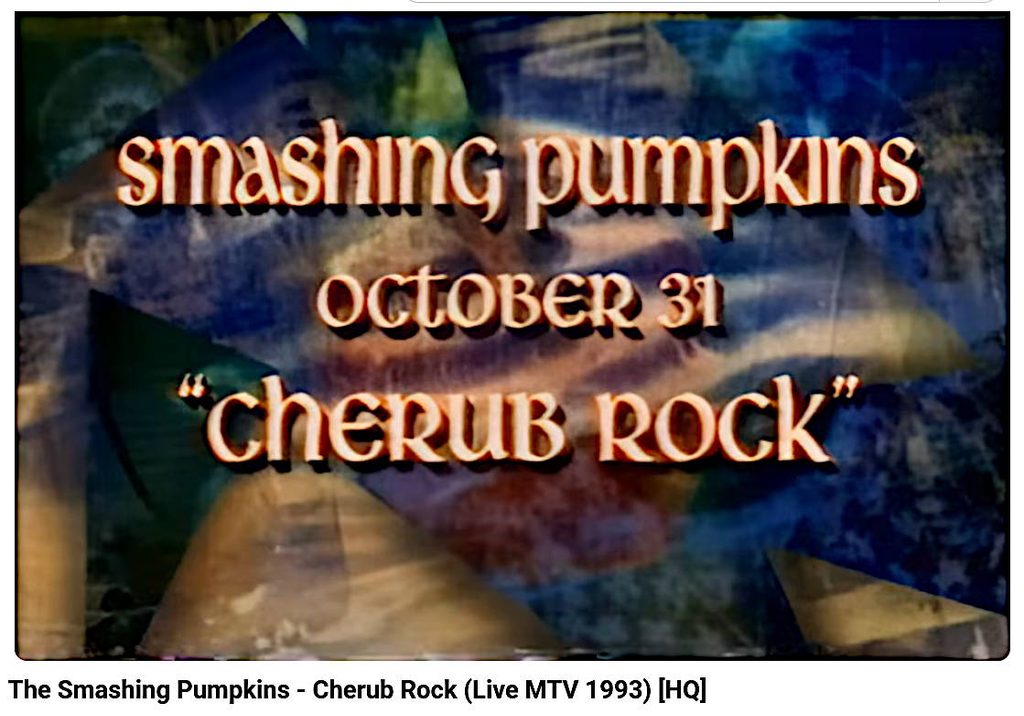
The connections are all right there: obviously, the band’s name itself, The Smashing Pumpkins. Secondly, the band famously played “Cherub Rock” with a lot of heavy fanfare live on MTV back on Halloween night in 1993. Lastly, the song incorporates some subtle religious undercurrents, and Halloween itself is deeply rooted as a Catholic holiday.
“Who Wants Honey?” and the Price of Success
Lyrically, the song tackles the bitter pill of trading counterculture credibility for mainstream success and corporate music industry cash. As captured in lines like:
“Who wants honey? / As long as there’s some money / Who wants that, honey?”
While the broader context points to a cynical swipe at the music industry, there’s also a deeply personal, human layer to that final line. When Corgan sings “Who wants that, honey?” it almost sounds like he’s turning away from the madness of fame to speak directly to a loved one—using “honey” as a term of endearment. It’s as if he’s dismissing the superficial rewards of the business together: sure, there’s money on the table, but who actually wants that fake life?

The Meaning Behind “Angels with Their Wings Glued On”
Looking closely at Verse 2, Corgan takes direct aim at the indie gatekeepers and music snobs of the early ’90s:
“But beware / All those angels with their wings glued on / ‘Cause deep down / They are frightened and they’re scared / If you don’t stare”
This is where the song’s title, “Cherub Rock,” and its spiritual imagery collide. In Christian tradition and art, cherubim and angels represent celestial purity and divine standing. But by singing about angels whose wings are glued on, Corgan is talking about phonies and poseurs.
In the indie rock scene of the time, self-righteous purists acted like moral saints, attacking bands like the Pumpkins for signing to a major label. Corgan’s satirical message is that these critics are wearing fake wings. They want to look holy, pure, and elite, but underneath, they are terrified of losing their subcultural status. By titling a heavy, distorted rock anthem “Cherub Rock,” Corgan leans into that irony—acknowledging that neither he nor his cynical critics are pristine, unblemished angels.
Given Corgan’s childhood background navigating strict religious settings and Latin masses, he naturally repurposed religious archetypes of fallen purity to dissect human insecurity and corporate soul-selling.
(For a deeper dive into the song’s creation and the indie backlash, you can check out American Songwriter’s breakdown of “Cherub Rock” and the background facts on Songfacts.)
Internal Friction and the 1993 MTV Live Explosion
The internal friction within the band was legendary. Bassist D’arcy Wretzky later described her final years in the group as agonizing, pointing the finger at Billy Corgan’s micro-managing, controlling, and “insufferable” style. Corgan, conversely, contended that the friction stemmed from her severe internal breakdowns and erratic behavior. Music critics often note that both sides probably held a piece of the truth—a volatile cocktail of massive artistic pressure, mental strain, and the heavy price of giving in to the music industry machinery.
Check out the band performing it live on MTV on Halloween 1993 right here:
Though Corgan walked away from formal church at an early age, his lyrics and worldview have always wrestled with grand spiritual themes, angels with wings, and existential redemption.
Angels, Cherubs, and Dostoevsky’s Alyosha
That word—cherub—brings up an interesting cross-section of literature and theology.
A cherub isn’t just a chubby Renaissance artwork with wings; in biblical tradition, cherubim are fierce, high-ranking celestial guardians protecting sacred spaces (like the Garden of Eden, Ark of the Covenant, and the Tree of Life).
The Celestial Guardians: A Scriptural Index
To trace how these guardians appear across sacred history, the searchable index below tracks nearly 50 key references1 spanning the Old Testament (Catholic Canon), the New Testament, and the apocryphal Enoch literature.2
| Reference | Book | Context / Tradition |
|---|---|---|
| 3:24 | Genesis | Guard the east of Eden with a flaming sword |
| 25:18–20 | Exodus | Golden cherubim hammered on the ends of the mercy seat |
| 25:21–22 | Exodus | God promises to meet Moses from above the mercy seat between the cherubim |
| 26:1 | Exodus | Cherubim masterfully woven into the tabernacle curtains |
| 26:31 | Exodus | Cherubim woven into the veil of the Holy of Holies |
| 36:35 | Exodus | Veil of the tabernacle crafted with cherubim |
| 37:7–9 | Exodus | Bezaleel constructs the gold cherubim over the Ark |
| 7:89 | Numbers | Moses hears the Voice speaking from above the mercy seat between the two cherubim |
| 4:4 | 1 Samuel | The Lord of Hosts is enthroned above the cherubim |
| 6:2 | 2 Samuel | God's presence sits enthroned upon the cherubim |
| 22:11 | 2 Samuel | God rides upon a cherub during a dramatic theophany |
| 6:23–28 | 1 Kings | Solomon builds two massive 10-cubit olive-wood cherubim in the inner sanctuary |
| 6:29 | 1 Kings | Walls of the inner and outer houses carved with cherubim, palm trees, and open flowers |
| 6:32 | 1 Kings | Doors of olive wood carved with cherubim and palm trees overlayed with gold |
| 6:35 | 1 Kings | Temple doors overlaid with gold fitted tightly over carvings |
| 7:29 | 1 Kings | Bronze stands decorated with cherubim, lions, and oxen frames |
| 7:36 | 1 Kings | Plates of the stands engraved with cherubim, lions, and wreaths |
| 8:6–7 | 1 Kings | The priests bring the Ark under the protective wings of the cherubim |
| 19:15 | 2 Kings | Hezekiah prays to God who is "enthroned above the cherubim" |
| 3:7–13 | 2 Chronicles | Solomon overlays the Most Holy House with gold and massive cherubim |
| 3:14 | 2 Chronicles | The veil made of blue, purple, and crimson with cherubim worked thereon |
| 5:7–8 | 2 Chronicles | Priests place the Ark beneath the widespread wings of the cherubim |
| Appendix (Ch. 3-8) | 2 Chronicles | Details on Temple architecture, pillars, and engraved cherubim motifs |
| 18:10 | Psalm | Parallel text to 2 Samuel 22:11: God flies upon a cherub on the wings of the wind |
| 80:1 | Psalm | Shepherd of Israel, "enthroned above the cherubim, shine forth" |
| 99:1 | Psalm | The Lord reigns; let the peoples tremble, He is "enthroned above the cherubim" |
| 37:16 | Isaiah | King Hezekiah addresses God of Israel, "enthroned above the cherubim" |
| 1:4–28 | Ezekiel | The terrifying, multi-faced living creatures/chariot vision by the river Chebar |
| 9:3 | Ezekiel | The glory of the God of Israel goes up from the cherub to the threshold |
| 10:1–2 | Ezekiel | Coals of fire scattered over the city from between the cherubim |
| 10:3–8 | Ezekiel | The glory of the Lord stands above the house; cherubim wings spread |
| 10:9–17 | Ezekiel | Detailed anatomic breakdown of the wheels and cherubim mechanics |
| 10:18–22 | Ezekiel | The glory of the Lord departs and rests upon the cherubim |
| 11:22 | Ezekiel | Cherubim lift their wings with the wheels of divine presence beside them |
| 28:14 | Ezekiel | The king of Tyre addressed as the "anointed cherub who covers" placed in Eden |
| 28:16 | Ezekiel | The protective cherub expelled from the mountain of God for iniquity |
| 41:18 | Ezekiel | Temple walls carved with alternating cherubim and palm trees |
| 41:20 | Ezekiel | Carvings span from the floor to above the door in the temple hall |
| 41:25 | Ezekiel | Temple doors carved with cherubim and palm trees just like the walls |
| 49:8 | Sirach (Deuterocanonical) | High priest praised; cherubim depicted flanking the mercy seat |
| 3:55 | Daniel (Septuagint/Catholic) | Song of the Three Young Men calling upon heavenly powers and cherubim to bless God |
| 9:5 | Hebrews (New Testament) | Explicit mention of the "cherubim of glory shadowing the mercy seat" |
| 14:11 | 1 Enoch (Pseudepigrapha) | Fiery cherubim stationed between the structure of the heavenly worlds |
| 14:18 | 1 Enoch (Pseudepigrapha) | Vision of the crystal throne surrounded and supported by cherubim |
| 61:10 | 1 Enoch (Pseudepigrapha) | Listing the ranks: "The Cherubic, Seraphin and Ophannin" |
| 71:7 | 1 Enoch (Pseudepigrapha) | Enoch describes the heavenly guards and cherubim surrounding the throne of glory |
| 20:1 | 2 Enoch (Slavic) | Enumeration of archangels, rulers, and the standing order of cherubim |
| 21:1 | 2 Enoch (Slavic) | Cherubim and seraphim covering the outermost celestial throne, chanting the Trisagion |
In The Brothers Karamazov—a book I’ve been reading and posting about recently—Grushenka and others affectionately refer to young Alyosha as a “cherub” alongside titles like “hero.”
“I don’t know, I don’t know what he told me, my heart heard it, he wrung my heart…He’s the first to pity me, and the only one, that’s what! Why didn’t you come before, you cherub,” she suddenly fell on her knees to him, as if beside herself. “All my life I’ve been waiting for such a one as you, I knew someone like that would come and forgive me. I believed that someone would love me, a dirty woman, not only for my shame…!”
Grushenka, speaking of Alyosha (The Brothers Karamazov, Part III, Book VII, Ch. 3, trans. Pevear & Volokhonsky, p. 379)
This highlights his radical innocence, purity, and steadfast moral standing in a dark, cynical world—acting almost like a spiritual guardian amid the chaos.
When you flip through a reference like Bible for Dummies, figures like Enoch and the nature of cherubim pop up with similar multi-layered guardian imagery.3
“To further ensure that humans don’t return to eat from the Tree of Life, God places armed guards, called cherubs (Hebrew cherubim), at the entrance to Eden.”
Jeffrey S. Geoghegan and Michael O. Homan, The Bible For Dummies (Ch. 3, p. 46)
It makes you wonder how these fierce heavenly protectors tie back to a night of ghosts and goblins.
The True Hallowtide: Beyond the Spooky
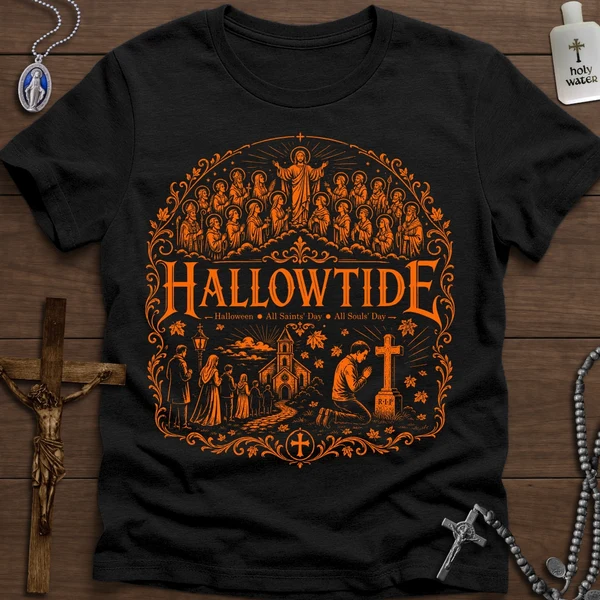
Hardcore Catholics describes this shirt as a Hallowtide Triduum Catholic T-Shirt.
Hallowtide begins where modern Halloween usually ends. This three-day Catholic season—All Hallows’ Eve, All Saints’ Day, and All Souls’ Day—calls us to look beyond the spooky and reclaim a forgotten rhythm of the Church centered on the saints, the faithful departed, and the hope of Heaven.
Three states. One Mystical Body. United in Christ. Fight. Pray. Rejoice.
As it turns out, Halloween isn’t just about candy and costume parties—Halloween is a profoundly Catholic holiday. The term itself originates from All Hallows’ Eve, the sacred vigil leading directly into All Saints’ Day (November 1st) and All Souls’ Day (November 2nd).
As the Good Catholic guide points out, All Hallows’ Eve is a preparation to honor the holy men and women of heaven—both the famous saints and the countless ones whose names are entirely unknown to us. It’s a reminder that the spooky veil of late October actually opens up into a rich, solemn Christian calendar celebrating eternal life and spiritual communion.
Closing Words
From a modest backyard harvest of homegrown pumpkins and smaller watermelons to 1993 MTV live broadcasts of The Smashing Pumpkins, the autumn season always bridges the gap between the earthly and the uncanny. Whether we are reflecting on the pressures of the music industry, the literary innocence of Dostoevsky‘s cherubs, or the historic Catholic roots of Hallowtide, Halloween remains a uniquely reflective time of year.
Have a safe, happy, and thoughtfully spooky Halloween!
Footnotes
- Cherubim are referenced approximately 100 times across these sources: ~93 in the OT (Catholic canon), 1 in the NT (Heb 9:5), ~5 in 1 Enoch, and ~4 in 2 Enoch. ↩︎
- Note on Apocryphal Texts: References include both 1 Enoch (an ancient Jewish apocalyptic work preserved primarily in the Ethiopic Church canon) and 2 Enoch (a later Jewish-Slavic apocalyptic text surviving in Old Church Slavonic manuscripts, which are not formally recognized in standard biblical canons). ↩︎
- In general biblical scholarship, Enoch is primarily recognized as an ancient figure and author of the apocryphal Book of Enoch, which expands on angelology by describing Cherubim as high-ranking, non-sleeping guardians of God’s throne alongside Seraphim and Ophanim. ↩︎

