

History doesn’t always repeat itself, but market cycles sure do. If you look at a snapshot of the American beverage landscape today, it’s hard to imagine a time when local taprooms weren’t on every corner. But the 150-year history of U.S. brewing isn’t a steady climb—it’s a dramatic, high-stakes rollercoaster defined by massive booms, near-total government wipeouts, and fierce corporate consolidation.
With active U.S. breweries skyrocketing past 9,000 in recent years, a looming question hangs over the industry: Is the craft beer boom heading for a historic correction?
To find out, we have to look back at how we got here. The Brewers Association data tells a fascinating story across three distinct chapters:
A 150-Year History in Three Acts
1. The 19th-Century Peak & Pre-Prohibition (Late 1800s–1919)
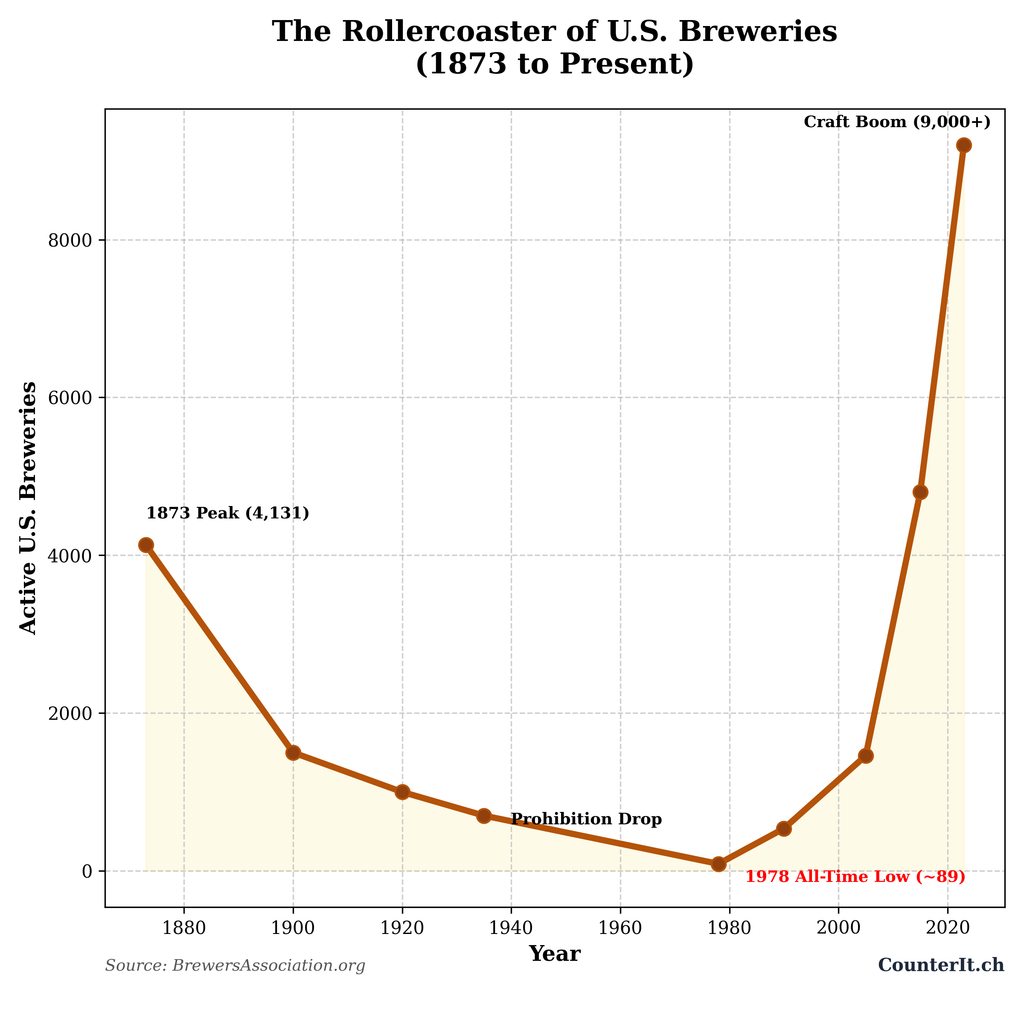
- The Starting Line (1873): The chart starts tracking in 1873, recording 4,131 operational breweries in the United States. Driven largely by German immigration and the popularization of lager, the U.S. maintained a dense network of local, community-based breweries.
- The Slow Decline: As the temperance movement gained momentum heading into the 20th century, combined with corporate consolidation and the lead-up to World War I, the number of active breweries began shrinking steadily.
2. The Prohibition Collapse & Industrial Desert (1920–1970s)
- The Prohibition Wipeout (1919–1933): When the 18th Amendment took effect, fewer than 1,000 breweries were left, and the passing of Prohibition wiped out legal commercial brewing almost entirely.
- Post-Repeal Consolidation: When Prohibition ended, the few breweries that managed to survive or revive were mostly massive industrial macro-breweries. By the late 1970s, fierce market consolidation and mass-produced light lagers reduced the entire country’s active brewery count to an all-time low of fewer than 90 operational breweries nationwide.
3. The Craft Beer Renaissance (1980s–Present)
- The Spark: The counter-movement began with the legalization of homebrewing federally in 1978 and the rise of pioneers like Anchor Brewing and Sierra Nevada in the early 1980s.
- The Modern Boom: If you slide the bar forward into the 2000s and 2010s, you will see a near-vertical hockey stick curve. The count blew past the old 1873 record in 2015 (surpassing 4,000) and continued surging to over 9,000 operational craft and independent breweries, creating a landscape far more decentralized than even the 19th-century peak.
The Bottom Line: What Comes Next?
History shows that when industries experience explosive, hockey-stick growth—whether in the late 1800s or the modern craft era—market saturation inevitably follows. While we likely won’t see a repeat of Prohibition, today’s independent breweries face a tough cocktail of rising operational costs, shifting consumer habits, and crowded shelves.
The question isn’t whether a correction is coming, but how the modern craft landscape will adapt.
What’s your take? Are we heading for a major wave of brewery closures, or will local taprooms prove more resilient this time around? Let us know in the comments below!

