

Many are obsessed with AI chips and model benchmarks, yet two far less glamorous realities decide how fast this buildout actually moves—and how painful things get if timelines slip: physical grid construction and the fixed income markets (including Credit Default Swaps).
I was thinking about both after watching Steve Eisman’s recent conversation on The Diary of a CEO.
You Can Build a Data Center and Have Nothing to Plug It Into
Years ago, we wrote about how the U.S. electric grid was structurally fragile—weighed down by aging equipment, deferred maintenance, and slow-moving utility incentives. Today, that fragility is colliding directly with AI’s appetite for electricity.
When people debate power constraints, they usually picture massive nuclear plants or gas turbines taking years to permit and construct. Those delays are real, but Eisman highlighted two ground-level bottlenecks that hit much sooner (around the 34:50 mark):
- Local politics and reset clocks: Getting power, water, and land approved isn’t a single federal decision—it happens town by town and state by state. If local opposition stalls a project in one state and a hyperscaler pivots to a friendlier one, they don’t just pick up where they left off. They start the permitting queue over, losing roughly two years while bidding against everyone else chasing the same scarce sites.
- Not enough poles to get power from A to B: Eisman read a Substack note from an electrical engineer running a firm involved in AI data center construction in Michigan who summed up the binding constraint bluntly: it isn’t money, it’s power. Companies can finish building a data center and still have nothing to plug it into, because the construction system itself is so strained that there aren’t even enough utility poles and lines to move electricity where it needs to go.
As Eisman put it, the result isn’t necessarily an overnight halt—it’s slower progress, higher costs, and companies spending billions while getting less capacity per dollar.
When CapEx Meets Fickle Fixed Income Markets (and CDS)
Once AI infrastructure becomes this capital- and debt-intensive, tech companies stop living purely off cash flow and become beholden to the fixed income markets. And as Eisman noted—pointing to debt-funded “neoclouds” like CoreWeave—bond and credit investors can turn fickle fast.
Having worked on Wall Street in a top global structured finance and securitization group—before leaving New York in 2003 as credit standards began deteriorating and heading out to Silicon Valley to cover semiconductors and enterprise software—watching physical chip cycles collide with credit-market plumbing feels remarkably familiar.
Credit Default Swaps (CDS) Explained
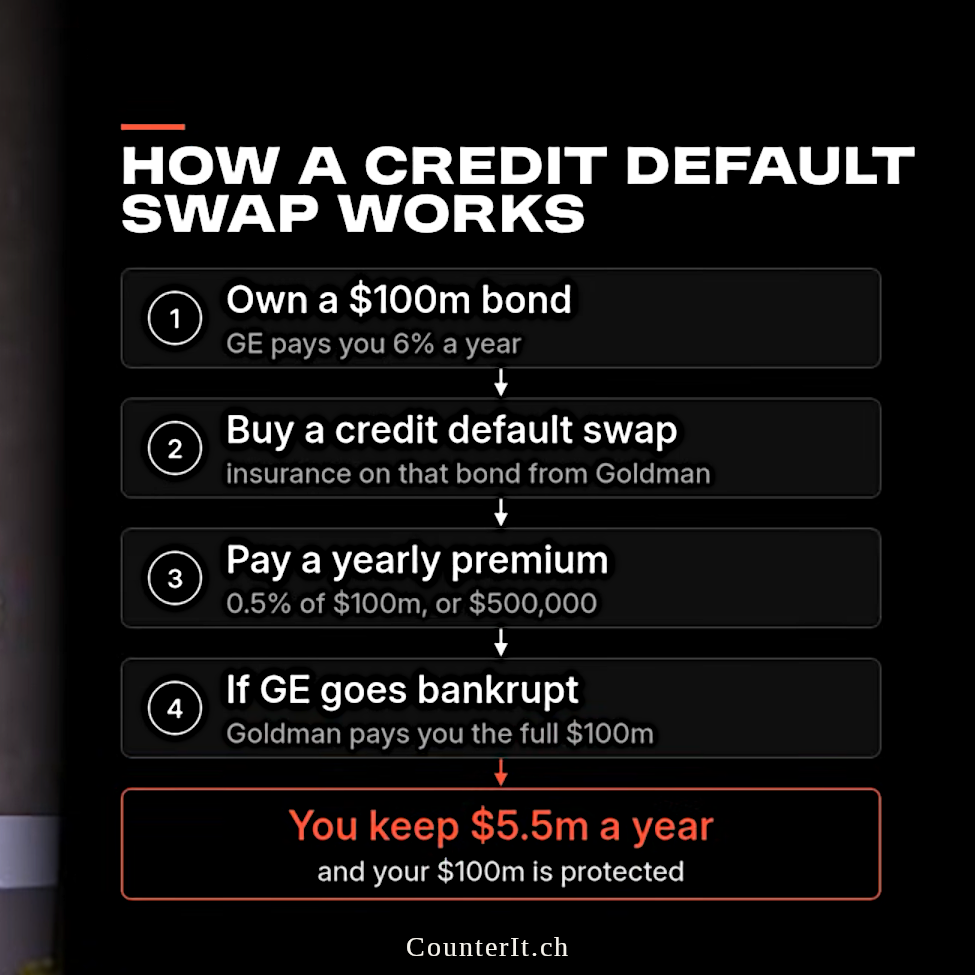
In the interview (around 9:26), Eisman stripped away the jargon around Credit Default Swaps (CDS) using a simple 5-step example:
- The bond: Suppose you own $100 million of 5-year GE bonds paying 6% a year. Chances are GE pays you back, but there is a non-zero chance of bankruptcy over those five years.
- Buying insurance: You go to Goldman Sachs and buy 5-year default insurance on that $100 million for 0.5% (50 bps) a year.
- The trade-off: You collect 6% from GE, pay 0.5% to Goldman, and keep 5.5%—sleeping well knowing Goldman writes you a $100 million check if GE goes bust.
- No underlying bond required: Because CDS contracts sit on dealer ledgers rather than stock exchanges, you don’t actually have to own GE’s bonds or stock. You can simply pay Goldman 0.5% a year—and still collect $100 million if GE defaults.
- Scaling the mispricing: In 2007, Eisman applied that exact mechanic to $700 million of subprime mortgage securitizations at 3% a year ($21 million/year)—a price he thought was absurdly cheap—generating roughly $1 billion for his fund when the subprime wave broke.
The Takeaway
Eisman himself is careful not to equate today’s AI cycle with 2008—he views the dot-com boom as the closer parallel. Still, the connection between physical bottlenecks and credit pricing is hard to ignore. When billions in debt are raised upfront against future compute revenues, every delayed pole, stalled permit, or grid bottleneck stretches the payback clock—and CDS spreads are often where lender nervousness shows up first.