
If you spend any time running, cycling, or walking near wooded trails during the summer, you already know the frustration. Long before you even see them, deer flies start buzzing your head, zeroing in on the back of your neck and ballcap.
While looking for a simple way to keep them at bay without drowning in chemical sprays, I decided to try out TredNot Deerfly Patches. Here is a quick first look at how they work, where deer flies hit hardest (both here in the U.S. and globally), how the patches performed during my late-season test, and why they make a fantastic, inexpensive stocking stuffer for the upcoming holidays.
Deerflies vs. Horseflies: The Back-of-the-Head Ambush
Unlike horseflies—which tend to buzz lower around your ankles and legs and deliver a biting pinch—deer flies (Chrysops) are relentless head-hunters. They are drawn to movement, dark silhouettes, shadows, and body heat, making runners and cyclists prime targets as they attack from behind.
Like mosquitoes, deer flies breed near wet, sitting, or slow-moving water—bogs, marshes, damp soil, and shaded creeks—emerging once soil and water temperatures warm roughly into the 60–72°F (16–22°C) range.
How TredNot Patches Work
The concept is brilliantly simple. It’s a specialized strip of tape with strong adhesive on both sides. You peel off the backing and stick it directly onto the back of your ballcap or cycling helmet.
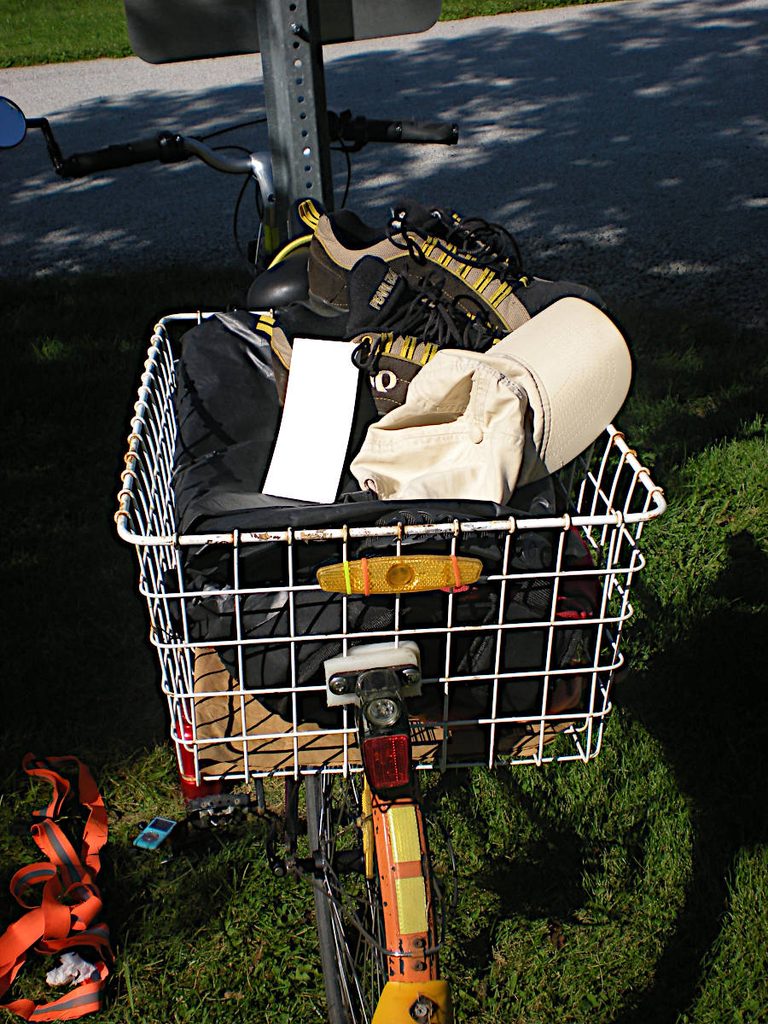
Pre-run setup: bicycle, ballcap, and an unattached TredNot patch ready for a late-August trail test.As you jog, ride, or walk, deer flies are attracted to the motion of your head, land on the back of your hat to bite, and get instantly trapped on the sticky surface. No heavy bug sprays, no complicated gear—just passive trapping.
My Late-Season Field Test on Northeast Ohio Trails
In Northeast Ohio and northern Michigan, deer fly season is intense and concentrated. When I run the Western Reserve Greenway from the North River Road trailhead all the way to Airport Road, the stretch from Johnson Plank to Airport Road consistently has the heaviest deer fly activity. Another notoriously brutal spot for both mosquitoes and deer flies is the tree-dense woods along Mosquito Lake in Cortland, Ohio near the Hillside Cemetery (around Main Street)—though I skipped running there this past season.
That spot is the Turkey Run Trail, a flat, 4.1-mile out-and-back dirt path along the eastern shore of Mosquito Creek Lake starting near Hillside Cemetery—a great birding and jogging route that connects to the Bloodroot, Burr Oak, and Deer Meadow loops, if you brave the bugs.
Anyway, I didn’t get my TredNot sample until the very last weekend of August, right at the tail end of our local window. Even so, as I started running, a couple of persistent flies immediately locked onto me. Within minutes, they landed on the back of my hat and got firmly stuck on the tape. By the very next weekend on my next run (Sat., 05 Sep.), the deer flies had completely vanished for the season.
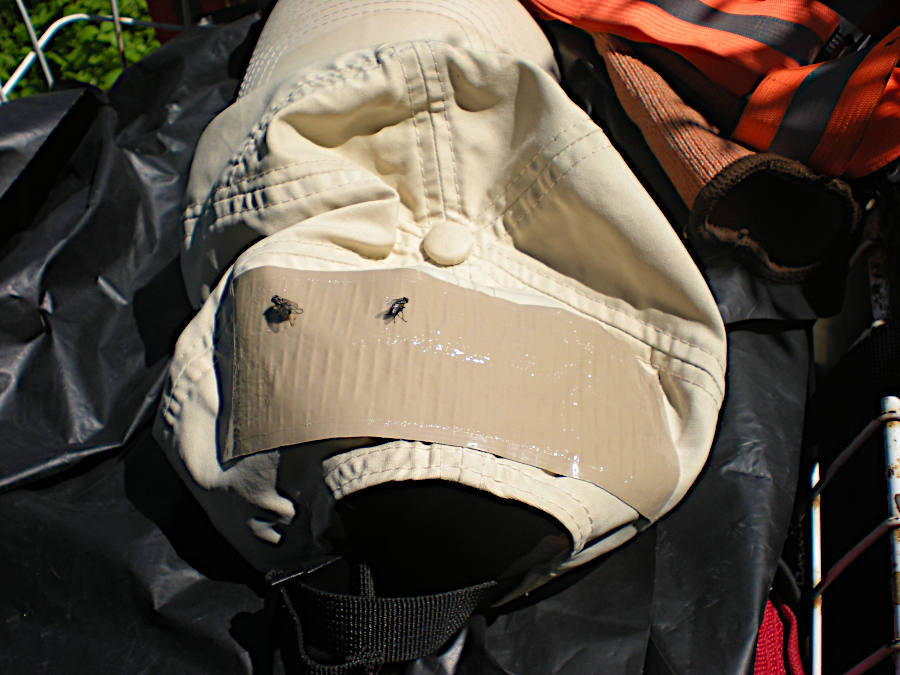
Late-August test on the Greenway: just two stragglers caught before the local season dropped to zero the following weekend.However, I look forward to using these patches next season, as my hat will probably look like the many examples submitted online by happy customers, like this one:
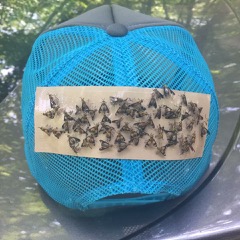
Peak-season reality: a customer photo from Janet S. showing how many flies a single patch can trap during June and July.Catching those two late stragglers proved right away that the tape does exactly what it promises—and sharing a peak-season photo from other users gives a much better look at what happens when you wear one in June or July.
Where Deer Flies Are Worst: U.S. & Global Exposure
If you travel to run, hike, or fish, deer fly timing depends heavily on climate and moisture:
- Across the U.S.: Deer flies live in every state except Hawaii. The Great Lakes and Upper Midwest (Michigan, Minnesota, Wisconsin, northern Ohio) experience a sharp, intense mid-summer surge, while the humid Southeast and Gulf Coast deal with overlapping generations from spring well into fall. Coastal salt marshes along the Northeast/Mid-Atlantic and localized river corridors or mountain meadows in the West also see strong summer activity.
- Around the World: Globally, Chrysops species appear on every continent except Antarctica—leaving Hawaii, Iceland, and Greenland as rare fly-free zones. Cooler northern regions across Canada, Scandinavia, Russia, and the UK (where they’re often called clegs or stouts) mirror northern Ohio’s short, intense summer hatch. Meanwhile, tropical and subtropical regions across Central/South America, Sub-Saharan Africa, and Southeast Asia see year-round or rainy-season activity.
| Region | Full Seasonal Range | Peak Activity Months | Seasonal Pattern |
|---|---|---|---|
| Great Lakes & Upper Midwest (MI, MN, WI, N. OH) | Late May – Late August | Mid-June – July | Sharp & intense: Snowmelt and warming bogs trigger a sudden, concentrated burst in early-to-mid summer. |
| Northeast & Mid-Atlantic (ME down to VA) | Mid-May – Early September | June – July | Coastal + inland waves: Inland woodland species peak in June, followed by coastal saltmarsh species (C. atlanticus) surging in mid-summer. |
| Southeast & Gulf Coast (FL, GA, LA, Carolinas) | April – October (year-round in S. FL) | May – August | Long & multi-generational: Warm springs bring early emergence, and high humidity sustains multiple overlapping broods. |
| The West (Pacific NW, Rockies, CA valleys) | May – August | Late June – July | Elevation-driven: Valley wetlands warm in May, while mountain meadows and snowmelt streams peak later in July. |
| Global Counterparts (Canada/Scandinavia vs. Tropics) | Boreal: June – August Tropics: Year-round | Boreal: July Tropics: Rainy seasons | Mirrors the North-South U.S. split—short boreal summers vs. moisture-driven tropical cycles. |
Interactive Map: U.S. Deer Fly Activity by Month
Click through the months below—or tap any state—to see how deer fly activity expands across the U.S. in June and July before retreating back toward the Gulf Coast by September:
U.S. Deer Fly Activity & Peak Season by Region
Select a month to see how the active season shifts, or click any state for local details.
Perfect for Black Friday & Christmas Stocking Stuffers
As we roll past Thanksgiving and head straight into Black Friday (or Cyber Monday) and Christmas shopping, we’re all looking for small, practical gifts that don’t break the bank (and yes, if any friends or family are reading this, consider this a subtle hint for my stocking).
At around $10 for a 12-pack, TredNot patches are made in the USA in northern Michigan by a family-owned and operated company1 and make an ideal stocking stuffer for:
- Trail runners, joggers, and cyclists
- Hikers and campers
- Fishermen, kayakers, and gardeners
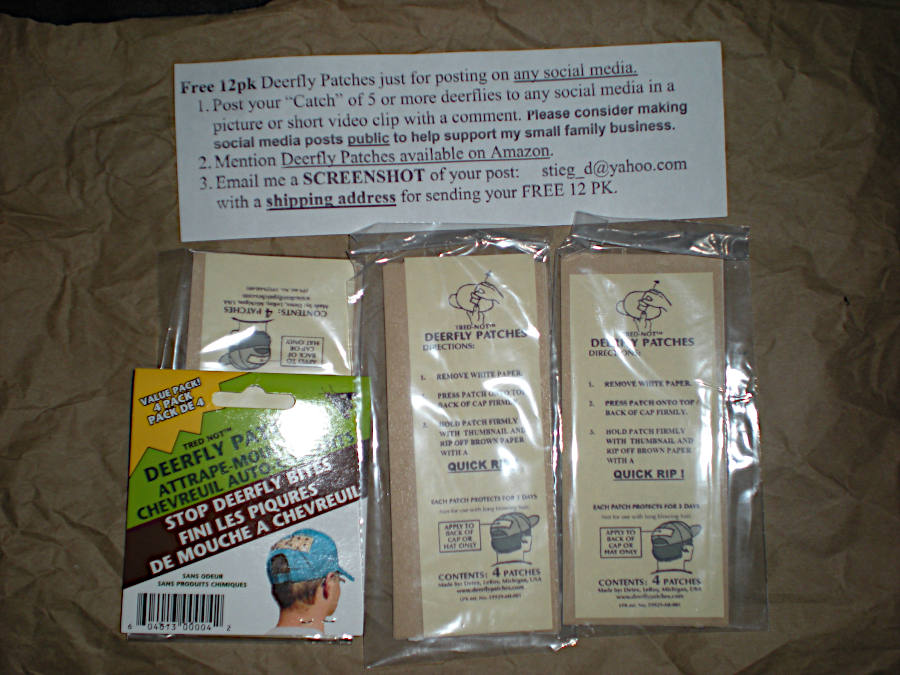
As you may see in my package of the TredNot Deerfly Patches, the company provides an offer to receive a free 12-pack if you share a picture on social media with at least five flies stuck on your patch:
Free 12pk Deerfly Patches just for posting on any social media.
- Post your “Catch” of 5 or more deerflies to any social media in a picture or short video clip with a comment. Please consider making social media posts public to help support my small family business.
- Mention Deerfly Patches available on Amazon.
- Email me a SCREENSHOT of your post: stieg_d [AT] yahoo.com with a shipping address for sending your FREE 12 PK.
Where to Pick Them Up
- Direct from TredNot: Deerfly Patches – 12 patches (Three 4/pks). $11.95.
- Amazon:
12 / Pk Deerfly Patches/TredNot Deer Fly Patch Odorless Repellent. $9.97. - Other Stores (there are many):
Planet Natural (Bozeman, MT)—Deerfly Patches (12pk). $9.97;Northwest Outlet (Superior, WI)—Tred-Not Deer Fly Patches 4-Pack. $4.99. (Note: Because the company also manufactures white-label patches for other brands, you can find identical patches sold under different outdoor labels at many local hardware and sporting goods stores.)
Looking Ahead
These patches are affordable, lightweight, and flat-out effective. I’ll be keeping a pack handy and will post a full, peak-season update next spring and early summer (around Northeast Ohio — Trumbull County) when the deer flies return in full force.
Have you tried TredNot patches—or another low-tech trick—on your runs yet? Let me know how they worked for you in the comments!
Footnotes
- TredNot is family-owned and operated out of northern Michigan, where its patches are manufactured in the USA. I’ll share a closer look at the founder’s backstory on how the company got started—alongside fresh peak-season trail photos—in my Summer 2027 follow-up post. ↩︎