I acquired a pair of big, beautiful bumper plates a couple of days ago when I had to go to Cleveland for an appointment.
What follows is a recap of my renewed fitness journey expedition over the past two-years whereby I went from a balloon-like 37″ waist to a more healthy, for me, 32″ waist.
I essentially lost fat and added muscle. That, in itself, is the equivalent to “the art of the deal,” too.
How It Started
Feb. 2024
When I began exercising again after many years of not doing so, I wrote back in February 2024 that a chin-up bar and a single dumbbell were sufficient for my exercise requirements. The dumbbell had a total of 50 pounds of 5-lb iron plates that could be used:
I only have one dumbbell. It has ten five-pound iron plates. So I can put a total of 50 pounds on the dumbbell. That amount is way more than I’d want, or need, to use for any exercise. So, I’m fine with this dumbbell and amount of weight.
CounterIt.ch: “I Gave up Not Exercising for Lent This Year.” (Feb. 2024)
Nov. 2024
In November 2024, as I got stronger, I dusted off my old weight bench that was made by a high school student in metal shop back in the 1970s or 1980s. It was built like a tank and relatively heavy for its compact size. I also had some weight plates for the 1” diameter bar. A total of about 200 pounds or so of iron and plastic weights.
I still have more of these plastic weights with the cement interiors; perhaps another hundred pounds sitting in my dad’s basement. The bench and weights were what my brother and I used in high school.
How It’s Going
Feb. 2025
My set-up was not real safe, and I was concerned about the following:
- Questionable stability of the bench — mainly concerning tipping over sideways or flipping over the top.
- The 1″ bar is not suitable for weight greater than 100–200 pounds or so.1I used this bar as a teenager and would load it up with 275–295 pounds, and it would bend and bounce during the bench press; I’m fortunate it didn’t snap!
- No safety bars, particularly for bench pressing.
The latter wasn’t a major concern, since I don’t use bar clamps to secure the plates on the bar. The reason for doing so is that if I struggle to get the weight off of my chest, then I could tip the bar sideways to dump the plates off of one end. That’s a life-saving maneuver.
However, there is still a small risk of passing out or having the bar slip out of my hands and then having the weight crush my chest or neck. As a teenager, this never really crossed my mind, and I almost always lifted weights by myself.2In my teens, I’d just roll the weight off of my body when I couldn’t lift it up. Not pleasant, but it worked. As a wise adult, it does cross my mind, especially since I still lift by myself and I know I’m not invincible. So, I ended up trading and selling some of my equipment and such for a safer set-up.
I got a wonderful deal from a guy who was getting rid of his weight lifting equipment. He was clearing out his shed, which he had converted to a work-out space, to make room for his motorcycle. I’m thinking his wife might have asked him to choose between the motorcycle and the exercise equipment, and he chose the former.
Rack, Olympic bar, bench, and bumper plates
Anyway, in that deal, I got a Grind Chaos4000 Half Rack, an adjustable bench (incline/decline), and 260 pounds of bumper plates!3One can still buy bumper plates that are the equivalent to Grind’s, but as the PRx brand, which is the parent company of Grind Fitness. I think he might have purchased these items as factory “seconds,” since they have some manufacturing flaws. They were only about a year old, and he said he only used them for six months.
To my surprise, the paint on the frame had peeled in many spots, and then surface rust developed. I called the manufacturer and its representative said that the powder coat paint generally can withstand the freezing temperatures, but said it may have been a combination of being too damp and a flawed powder coat application. I believe it was largely the latter.
The rack, itself, though is solid. It also has holes at the bottom to bolt into a floor system. The only design feature that I’d change, besides converting to a full power cage, is to have the holes in the posts separated by 1″ instead of 2″ in the usable range related to the bench press and squats. This would enable a more precise setting for the safety bars. So, anyone in market for power cages and half-racks should really only buy the racks that have this design feature, all else equal.
I also got a used Olympic bar4The brand is YESUNEED. Specs are 87 inches long, threaded barbell, 190K PSI Rated for 700 Pounds. New price on Amazon is $112. from somebody else and a few small iron plates totaling 15 pounds (a couple of 2.5 lb and 5.0 lb plates). So, in total, I had 320 pounds to work with.
Nevertheless, as I wrote at year-end 2025, I was already working-out with 255 pounds in the dead-lift exercise. So, I figured I’d need to get more weight plates by summer 2026.
Mar. 2026
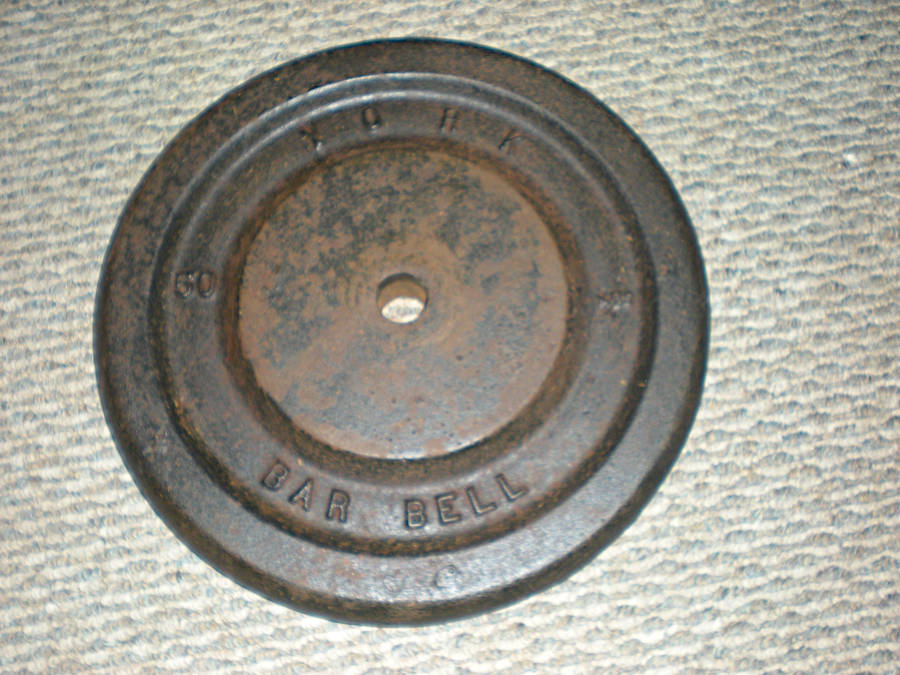
My second Art of the Barter Trade Deal involved three parties, but it ultimately entailed a net-zero cash exchange by me. I essentially traded a pair of 50-lb vintage, Made-in-the-USA, York iron plates that fit a 1” diameter bar, pictured below:
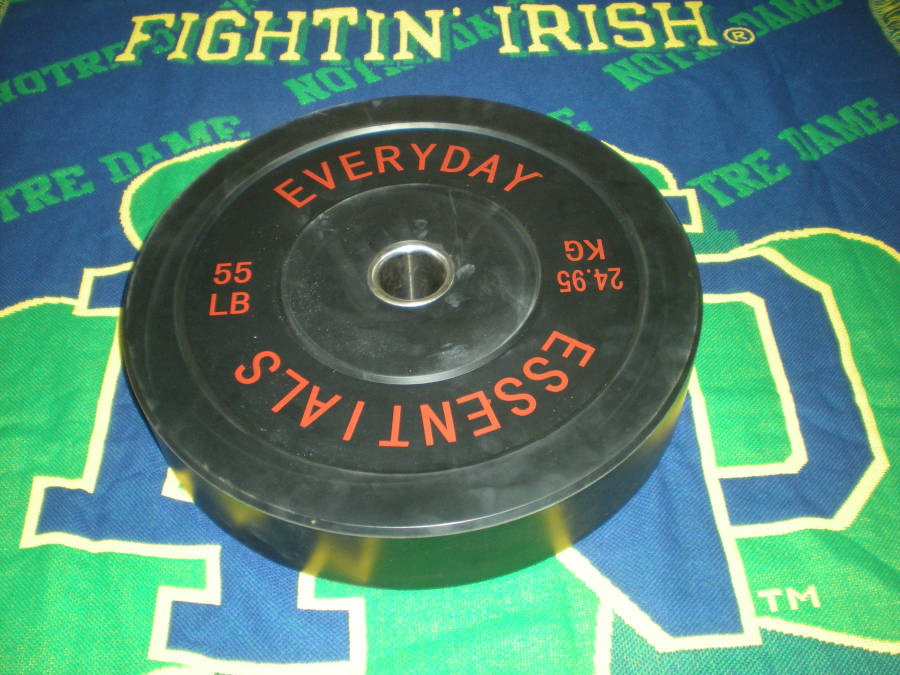
…for a pair of 55-lb Everyday Essentials (Walmart brand) bumper plates, which fit a 2” diameter Olympic bar, pictured below.
Current Set-up
Here’s my current set-up of the Grind Chaos4000 Half Rack, bench, Olympic bar, and bumper plates:
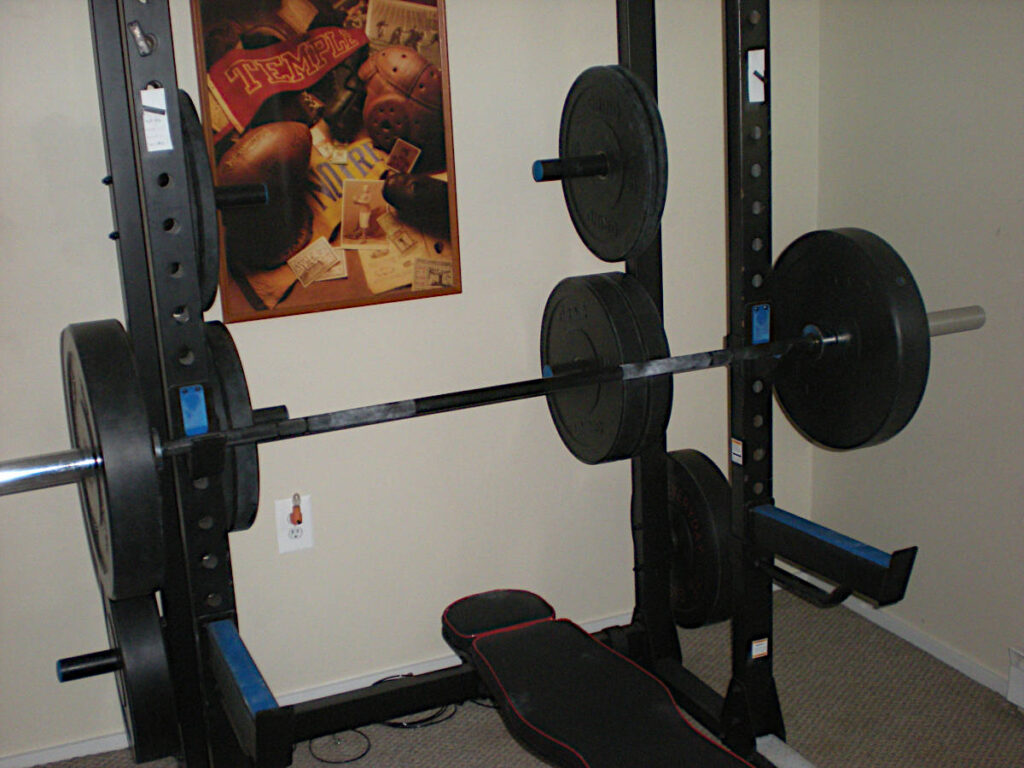
In the picture, the bar has two 45-pound plates on it, so it’s 135 pounds total, including the weight of the 45-pound Olympic bar. The 55-pound plates are on the storage bars on the lower sides of the rack. The other plates on the rack are the Grind brand, which include pairs of 10, 15, 25, and 35 pound plates.
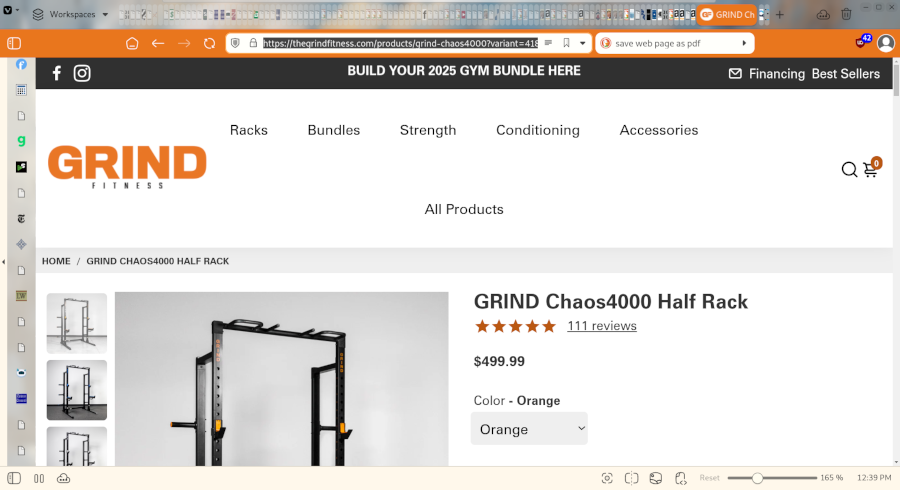
Furthermore, Grind was a separate company and brand working out of the facilities of PRx Performance,5This is an archive link to a Grind full-cage. These are generally preferable to half-racks; however, the Chaos4000 Half Rack was considered an upgrade to this particular full cage. It also cost $150 more, as new. Reference the image I presented that shows the new list price for the Chaos4000 half-rack of $499. which is based in Fargo, North Dakota. As of recently, Grind Fitness is now officially part of PRx Performance.
In total, I now have 430 pounds,6Grind plates: 260 lbs.; small iron plates: 15 lbs.; Everyday Essential plates: 110 lbs.; Olympic bar: 45 lbs. = 430 pounds. including the weight of the bar. However, given the current figuration of plate sizes, only 425 pounds will fit on the bar. This is due to the thickness of basic bumper plates (not competition style, which are thinner) relative to standard Olympic iron plates.
Pricing
As for the pricing, here’s a summary of what some of these products sell for brand new at regular price and at any discount price.
Weight plates: price per pound comparison
| Item (price/pound) | New (regular) | New (discount) | Used (my deal) |
|---|---|---|---|
| York 1” vintage iron plates | $2.40 | $1.56 | $0.80 |
| York 2” iron plates | $2.44 | - | - |
| Everyday Essentials (Walmart) bumper plates | $1.07 | - | $0.73 |
| Grind Fitness bumper plates | $2.69 | $1.14 | - |
Lastly, regarding pricing, one could buy brand new York 2″ traditional plates from wholesalers, instead of directly from York, which charges a lot for shipping. For example, Strength Warehouse USA sells the York iron plates for $2.44/pound, with free shipping, provided one buys a pair of 45 pound plates or multiple plates. Note, though, that York plates are no longer made in the USA, quite sadly. The vintage plates were made in the USA.
My dream set of weight plates would be cast iron instead of bumper plates, which happen to be more popular nowadays, but are less durable. I’d also want to have made in the USA plates—such as Rogue (Columbus, OH) or The Strength Co. (Waupaca, WI)—and a made in the USA Olympic bar.
However, if I were ever to acquire such a high quality, Made-in-the-USA set, then I’d need to designate my exercise space as the “Man Cave,” or better yet, the “Natty Joe Cave.”7A natty weightlifter is an individual who builds muscle and strength without the use of performance-enhancing drugs (PEDs) or anabolic steroids. This approach emphasizes natural methods, including: proper nutrition, consistent training, and adequate recovery.
Closing Words
In closing, I’m fairly sure that I won’t need any more weight than this, given my late fifty-something age.
Footnotes
- 1I used this bar as a teenager and would load it up with 275–295 pounds, and it would bend and bounce during the bench press; I’m fortunate it didn’t snap!
- 2In my teens, I’d just roll the weight off of my body when I couldn’t lift it up. Not pleasant, but it worked.
- 3One can still buy bumper plates that are the equivalent to Grind’s, but as the PRx brand, which is the parent company of Grind Fitness.
- 4The brand is YESUNEED. Specs are 87 inches long, threaded barbell, 190K PSI Rated for 700 Pounds. New price on Amazon is $112.
- 5This is an archive link to a Grind full-cage. These are generally preferable to half-racks; however, the Chaos4000 Half Rack was considered an upgrade to this particular full cage. It also cost $150 more, as new. Reference the image I presented that shows the new list price for the Chaos4000 half-rack of $499.
- 6Grind plates: 260 lbs.; small iron plates: 15 lbs.; Everyday Essential plates: 110 lbs.; Olympic bar: 45 lbs. = 430 pounds.
- 7A natty weightlifter is an individual who builds muscle and strength without the use of performance-enhancing drugs (PEDs) or anabolic steroids. This approach emphasizes natural methods, including: proper nutrition, consistent training, and adequate recovery.